

 +1-800-267-5763


RESIDENT TEACHING – Childhood Glaucoma’s
Date: Friday April 23, 2021
Time: 9:00 AM – 10:30 AM EST
Topic: Childhood glaucoma’s
Speaker: Dr. Asim Ali
Registration:
Zoom Link – https://us02web.zoom.us/j/83510355878?pwd=c0J0S2pTTUpGTnNDdWJVVkRzYmNuUT09
Passcode: X6DFb8
Cornea Surgical Video Learning Series
The next session of the Cornea Surgical Video Learning Series, co-moderated by Professor Sadeer Hannush (Wills Eye Hospital) and Professor Allan Slomovic (University of Toronto) and their respective Cornea Departments will be hosted on the following date:
Date: Thursday May 20th 2021
Time: 7:30 – 9pm EST
Keynote Lecture: “Implanting & Securing Posterior Chamber IOLs without Capsular Support using the Canabrava 4-Flanged Technique”- Dr Sergio Canabrava
Title: Implanting & Securing Posterior Chamber IOLs without Capsular Support using the Canabrava 4-Flanged Technique
Case Presentations:
- Gore-tex Sutured PCIOL Gone Bad – Dr Ashley Khalili
- Fixating IOL-Bag complex with the 4-flange technique – Dr Eyal Cohen
- Repair of traumatic iris dialysis and complex phacoemulsification – Dr Michael Mimouni
Accreditation
CPD points are available for attending these rounds as per the Royal College.
Access details:
Register in advance for this webinar here.
https://us02web.zoom.us/webinar/register/WN_bQyvcofMQk21gj0xmzV2Nw
After registering, you will receive a confirmation email containing information about joining the webinar.
This session will be recorded and placed online for future viewing. Past sessions may be accessed here also.
Choosing Wisely Canada National Meeting
Join the online FREE Choosing Wisely Canada National Meeting in collaboration with the Canadian Medical Association.
Date: May 12 and 13, 2021
This year’s National Meeting will explore the interplay between overuse and underuse, and how to prevent low-value services from diverting energy and resources from care that truly matters during these precarious times.
Bringing together health professionals, patients, system leaders, and researchers, this two-day virtual event is a unique opportunity to learn about leading Choosing Wisely efforts taking place across the country.
| Topics include: Using Blood Wisely Audit and Feedback Implementation Science Using Antibiotics Wisely Primary Care Reboot Nursing Implementation | Choosing Wisely Hospitals Fail Fest Serious Illness Conversations Deprescribing Abstract Presentations Freeing Up Capacity Post Pandemic |
At the National Meeting you will:
- Engage with the Choosing Wisely community in an energized exchange of ideas on overuse
- Hear about practical and implementable strategies for reducing overuse, and understand their impact
- Network with colleagues who share a commitment to reducing overuse
Learning Objectives
- Translate and apply best practices for reducing overuse in health care in their clinical settings
- Design effective approaches for evaluating interventions related to reducing overuse
- Develop strategies to share successful interventions across their health care organization
Accreditation
- ROYAL COLLEGE OF PHYSICIANS AND SURGEONS OF CANADA:
This event is an Accredited Group Learning Activity (Section 1) as defined by the Maintenance of Certification Program of the Royal College of Physicians and Surgeons of Canada, and approved by the University of Ottawa’s Office of Continuing Professional Development. You may claim a maximum of 8.25 hours (credits are automatically calculated). - COLLEGE OF FAMILY PHYSICIANS OF CANADA:
This one-credit-per-hour Group Learning program meets the certification criteria of the College of Family Physicians of Canada and has been certified by the University of Ottawa’s Office of Continuing Professional Development for up to 8.25 Mainpro+ credits.
Access details
All content included in the National Meeting will be presented free of charge. Register here.
Démarches factuelles dans le téléglaucome au Canada
avril 2021
RÉSUMÉ ANALYTIQUE
Le présent rapport fait le survol des démarches factuelles dans le téléglaucome (TG) utilisées au Canada en date de janvier 2021. Le TG consiste en un ensemble d’options qui ont recours à la télémédecine pour améliorer les soins prodigués aux patients présentant un glaucome (qu’il s’agisse de patients qui ont déjà reçu leur diagnostic ou qui sont exposés à un risque de glaucome). Ce document se veut un tremplin pour les ophtalmologistes du Canada qui souhaitent se lancer dans le TG.
Ce projet est le fruit des réflexions du Groupe de travail sur le téléglaucome de la Société canadienne de glaucome, qui est formé de spécialistes du glaucome et d’ophtalmologistes généralistes de partout au pays.
Depuis l’arrivée de la pandémie de COVID-19, nombreux sont les médecins qui se sont tournés vers les soins virtuels, ne serait-ce que partiellement. Trois axes justifient le recours général au TG. D’abord, on s’attend à ce que la demande en matière de soins ophtalmologiques au Canada augmente en raison du vieillissement de notre population et de la prévalence croissante des pathologies menaçant le pronostic visuel, comme le glaucome, la dégénérescence maculaire liée à l’âge et les cataractes. Or, l’amélioration de l’accès à ces services demeure un enjeu de taille dans un contexte de budgets réduits et d’un nombre limité de prestataires de soins. Ensuite, les populations rurales et éloignées sont depuis longtemps moins bien desservies en matière de soins spécialisés, et leur santé en souffre. En effet, l’équité en santé est au centre des préoccupations des politiques sanitaires canadiennes depuis des décennies, mais les progrès ne sont pas à la hauteur des attentes. Enfin, tant les patients que les prestataires de soins affichent une préférence marquée envers les soins virtuels parce qu’ils offrent des économies de temps et d’argent. Les soins virtuels représentent une solution réaliste pour répondre aux besoins de notre population en matière de santé, tout en permettant au système de santé de tirer la meilleure partie de ressources restreintes.
On trouvera, dans les pages qui suivent, les grandes lignes de trois modèles de TG accompagnés de cas cliniques de même qu’une proposition de configuration standardisée en vue du TG. Ces modèles – le module d’extension, le modèle à intégration numérique ou intra-cabinet et le modèle de collaboration12 – décrivent comment les médecins peuvent, de façon virtuelle, réaliser des dépistages (y compris le triage), faire des consultations et assurer la surveillance de leurs patients. Les médecins peuvent souhaiter ajouter l’un ou l’autre des éléments de ces modèles à leur pratique professionnelle, selon leur situation propre. Ce rapport admet également l’existence d’une lacune importante du TG, soit l’absence de gonioscopie. Les médecins doivent donc trouver des solutions de rechange pour évaluer le risque de glaucome à angle fermé.
Le lecteur trouvera également dans ce rapport des suggestions de schémas de pratique professionnelle, des outils pour réaliser les évaluations à distance, un résumé des enjeux médicolégaux et des aspects propres au permis d’exercice et à l’innocuité (y compris de manquer le diagnostic du glaucome à angle fermé et d’autres glaucomes secondaires), une synthèse des avantages et des défis du TG (notamment en ce qui a trait à la facturation), une réflexion sur l’avenir prometteur du TG ainsi que des recommandations sur la façon de surmonter les obstacles en vue d’optimiser les soins offerts dans un contexte virtuel.
La pandémie de COVID-19 nous a fait voir que les limites des soins virtuels sont en grande partie celles que nous leur attribuons. La progression des soins virtuels doit essentiellement trouver son élan de l’intérieur même du système de santé. Nous espérons que ce document outillera et inspirera les médecins à forger leur propre chemin dans la téléophtalmologie dans son ensemble, et dans le TG en particulier.
April 2021 Issue Highlights
The April 2021 CJO is now available online. Here are just a few of this issue’s highlights:
Resident Perspectives + visual abstract: Our residents have summarized 4 articles that are relevant to ophthalmology learners here in Canada and around the globe, including the article featured in our April visual abstract, Impact of the COVID-19 pandemic on characteristics of retinal detachments: the Canadian experience.
Original research articles:
- Micro-incision, trans-iridal aspiration cutter biopsy for ciliary body tumours [original research]
- Age-related differences in presentation and outcomes of anti-VEGF treatment of retinal vein occlusion [original research]
- Optical coherence tomography angiography findings in patients with COVID-19 [original research]
- Outcomes and complications of Boston keratoprosthesis type I implantation in unilateral versus bilateral corneal blindness [original research]
- Use of neuromuscular blocking drugs in strabismus surgery: systematic review and ophthalmology survey study [systematic review]
Research letters, photo essays, and case reports:
- Distribution of recurrence time intervals after anti-vascular endothelial growth factor therapy for myopic choroidal neovascularization [research letter]
- Canadian ophthalmology resident experience during the COVID-19 pandemic [case report]
- Serous retinal detachment following bronchoscopy-induced hypertensive emergency [case report]
- Late-onset spontaneous EX-PRESS shunt dislocation into anterior chamber [case report]
- Retinal ganglion cell loss in postmortem tissue of Alzheimer disease, glaucoma, and healthy normal subjects [case report]
Follow the CJO on social media:
- Twitter: @CanJOphth
- Instagram: @cjo_jco
- Facebook: CanJOphth
CONNECT THE DOTS – Webinar on Optimizing Diagnosis and Management of VKC

An online group-learning activity on vernal keratoconjunctivitis (VKC), focusing on diagnosis and management, with the goal of creating greater disease awareness to optimize care for children and adolescents suffering from VKC.
Schedule
Speaker: Dr. Asim Ali
Date: Monday, April 26th 2021
Time: 6:30 to 7:30 pm EST
Speaker: Dr. Devinder Paul Cheema
Date: Tuesday, April 27th 2021
Time: 6 to 7 pm PST / 9 to 10 pm EST
Target audience
This educational program has been designed to meet the educational needs of Canadian ophthalmologists involved in the clinical diagnosis and management of vernal keratoconjunctivitis (VKC).
Learning Objectives
At the end of this activity, participants will be able to:
- Recall the current diagnostic measures and criteria used to diagnose VKC
- Describe the graded treatment strategies available for patients having VKC
- Discuss the clinical evidence supporting the use of therapeutics in the treatment of severe VKC
- Evaluate how long-term care and follow-up of patients with VKC can be optimized
Accreditation
This program meets the accreditation criteria as defined by the Maintenance of Certification program of the Royal College of Physicians and Surgeons of Canada and has been accredited by the Office of Continuing Professional Development, Faculty of Medicine and Health Sciences, McGill University for up to 1 Section 1 credits/hours.
Access Details
To register to a CONNECT THE DOTS – Optimizing Diagnosis and Management of VKC webinar session, please follow the following steps:
- URL: https://registration.onlinelearningservices.ca
- Enter the webinar user code: 2063ST
- Select the webinar date of your choice and complete the required fields
- Click on the Add to Calendar option and verify that you have received the confirmation email
For further information or assistance with registration please contact the program organizers at [email protected].
For Residents: COSIG Annual Meeting 2021- Speed Mentoring Session
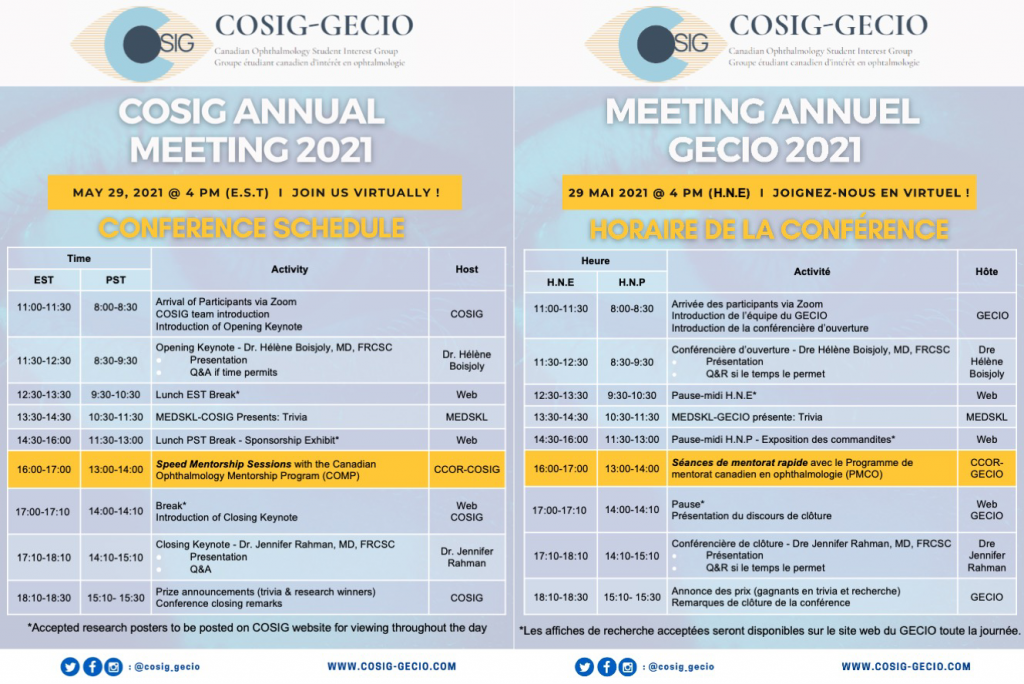
A group of Canadian medical students has formed a coalition called COSIG (Canadian Ophthalmology Student Interest Group) to help foster mentorship and share resources for all medical students in Canada interested in ophthalmology. As part of their first annual meeting, they are hoping to get ophthalmology residents from across Canada to take part in their 1 hour CCOR-COSIG Speed Mentoring Session.
CCOR-COSIG Speed Mentoring Session
Through a one-hour session, you will share your journey to ophthalmology with medical students across Canada. No preparation is required! You will be asked to provide insight on the life of an ophthalmology resident.
Date: Saturday, May 29, 2021
Time: 4-5 PM EST
Topic: global health and initiative
Structure: 4×15-minute breakout rooms on Zoom
CAM 2021 will be centered around the theme of global health and initiative. The keynote speakers are Dr. Hélène Boisjoly and Dr. Jennifer Rahman.
Here is the full schedule.
If you have any questions, please contact [email protected]
Webinar: Atropine – Fact or Folly
Topic: Atropine – Fact or Folly
Date: Saturday May 1st,
Time: 11:00 AM – 1:00 PM EDT / 8:00 – 10:00 AM PDT
Speakers: Dr. Kenneth Wright And Dr. Yi Ning Strube
Sponsors: Wright Foundation, Los Angeles, California
Queen’s University, Kingston, Canada
Learning Objectives
We will present evidence on the efficacy of using atropine for slowing progressive myopia and for treating amblyopia. Let’s look at the facts.
Registration
Please join us for a 2-hour complimentary Zoom seminar
RSVP: to- [email protected]
A zoom link and final details will be emailed to you prior to the meeting. Join us for a fun and interactive session!


Orbis Future Vision Leaders Program
Tomorrow’s eye health leaders making a difference today.
Orbis is a leading international non-profit that fights avoidable blindness and trains local eye care teams in developing nations so they can save sight in their communities. To offer residents and medical students the opportunity to participate in Orbis’ mission, Orbis Canada launched the Orbis Future Vision Leaders. This exciting new program creates an engaged community to network, learn, and create global impact, all while building awareness for avoidable blindness.
Through the special Orbis Speaker Series, networking events, and opportunities to speak to professionals in the field, members will gain important skills and insights that can help enhance their current education and future career opportunities.
Membership is free of charge and includes access to all Orbis events year round.
Target Audience
The Orbis Future Vision Leaders, is specifically made for medical students and ophthalmology residents.
Access Details
To register as a member and become part of your affiliated university chapter, please visit https://orbiscan.akaraisin.com/ui/FutureVisionLeaders