

 +1-800-267-5763


Workplace Eye Awareness Month: Protecting Vision in Professional Environments
Submitted by: Yosra Er-reguyeg

March is Workplace Eye Awareness Month, dedicated to promoting eye health and safety in professional settings. With over 700 work-related eye injuries occurring daily in Canada, protecting vision is a critical aspect of workplace safety. This PRC issue provides an overview of common workplace hazards and protective strategies; as well as a list of national resources to help providers promote workplace eye safety and awareness among patients.
Common Workplace Eye Hazards
- Flying Particles and Debris: metal shavings, wood splinters, dust, and other airborne materials can cause corneal abrasions or penetrate the eye, leading to severe damage.
- Chemical Exposure: industrial and healthcare professionals risk chemical burns from splashes and airborne vapours.
- Radiation Exposure: welders, laboratory workers, and those using high-intensity light sources face ultraviolet (UV) or infrared radiation risks, which can damage ocular tissues.
- Digital Eye Strain: office workers experience Computer Vision Syndrome due to prolonged screen use, leading to dryness, discomfort, and headaches.
- Infectious Disease Exposure: healthcare workers are at risk of eye infections from bloodborne pathogens or airborne contaminants.
Eye Protection Guidelines in Canadian Workplaces
- Usage of Canadian Standards Association (CSA)-certified protective eyewear: all protective eyewear in Canada must meet CSA Z94.3 standards to ensure impact resistance, UV protection, and durability.
- Prevention of digital eye strain in office settings: follow the 20-20-20 rule: every 20 minutes, take a 20-second break and look at something 20 feet away. Optimize your workstation by adjusting screen brightness, ensuring proper lighting, and positioning the monitor at eye level.
- Anticipation of workplace eye injuries: emergency eyewash stations should be easily accessible in workplaces handling chemicals and patients should seek medical evaluation as soon as possible.
Vision Care and Occupational Health Policies in Canada
- Many Canadian employers provide vision care benefits, but only15% of employees report satisfaction with their coverage.
- Occupational Vision Programs across Canada provide prescription safety eyewear to employees in industries requiring eye protection.
- Regular comprehensive eye exams can detect early signs of workplace-related vision issues and are encouraged by the Canadian Ophthalmological Society.
Workplace eye safety is essential for preventing injuries and long-term vision issues. Recognizing Workplace Eye Awareness Month is an opportunity to reinforce best practices and ensure clear vision for a productive workforce.
Resources on workplace eye safety
- CCOHS H&S Report (2014) – Use of CSA-approved eyewear and matching PPE to hazards ( CCOHS: Health and Safety Report – Past Issues ) ( CCOHS: Health and Safety Report – Past Issues ).
- Canada.ca – Protect Your Eyes! – qualities of good protective eyewear and care tips (Protect Your Eyes! – Canada.ca) (Protect Your Eyes! – Canada.ca).
- Canadian Association of Optometrists – reports ~75% of Canadians have digital eye strain symptoms (How Long Does Eye Strain Last? | Cochrane, AB).
- CCOHS – Office Ergonomics: Eye Discomfort – causes of screen-related eyestrain ( CCOHS: Office Ergonomics – Eye Discomfort in the Office ).
- CCOHS H&S Report (2019) – tips to prevent digital eye strain (20-20-20 rule, breaks, ergonomics) ( CCOHS: Health and Safety Report – Past Issues ) ( CCOHS: Health and Safety Report – Past Issues ).
- Benefits Canada (2022) – survey of remote workers’ increased eye issues (As employees’ screen exposure increases, is it time to update vision benefits? | Benefits Canada.com).
- CNIB – “In the Blink of an Eye…Avoiding Eye Injuries” – first aid tips for specks, blows, cuts, chemical splashes (In the blink of an eye … Avoiding eye injuries at work, home and play) (In the blink of an eye … Avoiding eye injuries at work, home and play).
- CCOHS – First Aid for Chemical Exposures – flush eyes ≥15 minutes for chemicals ( CCOHS: First Aid for Chemical Exposures ). CCOHS H&S Report – importance of eyewash stations ( CCOHS: Health and Safety Report – Past Issues ).
- Canadian Association of Optometrists – Best Practices Guide to Vision Benefits (2022) – stats on vision benefit satisfaction and missed work due to vision issues (Best Practices Guide to Vision Care Benefits) (Best Practices Guide to Vision Care Benefits).
- Canadian Ophthalmological Society – press release 2021 – urging regular eye exams (Canadian Ophthalmological Society shares eye-opening stats and tips for healthy vision during Vision Health Month – COS-SCO).
- Eyesafe BC (Doctors of Optometry) – overcoming barriers to PPE compliance with prescription safety eyewear (Eye Injury Statistics: Why Workers Won’t Use Safety Glasses – Eyesafe BC by British Columbia Doctors of Optometry) (Eye Injury Statistics: Why Workers Won’t Use Safety Glasses – Eyesafe BC by British Columbia Doctors of Optometry).
DOVS CORNEA ROUNDS – No Sutures, No worries: Mastering Flanged Scleral Fixation – VIA ZOOM
Date: Thursday, March 27th, 2025
Time: 5:00 – 6:00 PM (Eastern Standard Time)
Title: No Sutures, No worries: Mastering Flanged Scleral Fixation
Speaker: Professor Adi Einan Lifshitz
Zoom Link: Register in advance for this webinar
After registering, you will receive a confirmation email containing information about joining the webinar.
Objectives:
1. Understand the Principles and Indications for the Flange scleral fixation technique Master the Surgical Steps;
2. Recognize Complications, Postoperative Care and tips for success.
The VPP Grand Rounds Local and Visiting Professor Program is a self-approved group learning activity (Section 1) as defined by the Maintenance of Certification program of The Royal College of Physicians and Surgeons of Canada. You will be able to claim 1 credit for this round.
EyeNovation: Unveiling the pachychoroid disease spectrum: a deep dive into central serous chorioretinopathy and polypoidal choroidal vasculopathy
Join us for our next webinar in our EyeNovation: International Webinar Series for Ophthalmic Expertise!
“Unveiling the pachychoroid disease spectrum: a deep dive into central serous chorioretinopathy and polypoidal choroidal vasculopathy”, presented by Dr. Angie H.C. Fong, University of Hong Kong school of Clinical Medicine.
This engaging session exploring the evolving understanding of the pachychoroid disease spectrum (PDS) with a focus on central serous chorioretinopathy (CSCR) and polypoidal choroidal vasculopathy (PCV). This webinar will provide an in-depth review of pathogenesis, recent clinical trials, and emerging management strategies. Participants will also gain insights into the incidence and risk factors for PDS progression based on natural observation studies. This webinar will take place on Tuesday, March 25th from 7:00 – 8:00 PM ET.

Dr. Fong joined the Department of Ophthalmology, School of Clinical Medicine in February 2023 as Clinical Associate Professor of Practice. She leads the vitreoretinal service at the Queen Mary Hospital & Grantham Hospital where she is an honorary consultant. She is also an honorary consultant of the United Christian Hospital. Dr. Fong graduated from the University of Hong Kong with distinction in medicine & was the recipient of the Medic ’67 Gold Medal in Clinical Medicine for being top of her class. She completed her Masters in Public Health degree from the School of Public Health in HKU with distinction & is an HKAM accredited specialist in Ophthalmology. Having been awarded the Ho Hung Chiu Medical Education Foundation Scholarship, she went on to further her training in both surgical & medical retina under Prof. Peter Stalmans in Belgium & the Will’s eye hospital in the US. Her research interests include vitreoretinal surgeries, retinal imaging, macular & choroidal diseases, artificial intelligence & translational care. She was awarded 2 patents for her work on AI in OCT imaging in age related macular degeneration. She has 50+ publications in international peer reviewed journals & has co-authored a textbook in OCT imaging in central serous chorioretinopathy. She participates in major clinical trials with international sites in both the HKU & CUHK clinical trials centres.
Learning objectives
At the end of this session, participants will be able to:
- Assess the evolution and current understanding of the pathogenesis of pachychoroid disease spectrum (PDS) disorders.
- Integrate the diagnosis and management of central serous chorioretinopathy (CSCR) and polypoidal choroidal vasculopathy (PCV) by analyzing recent clinical trials and management strategies.
- Describe the incidence and risk factors for PDS progression in a natural observation study.
If you missed this webinar, not to worry! The recording is available below:
Understanding Uveal Melanoma: A Rare but Serious Eye Cancer
Submitted by: Joshua Huang
Reviewed and approved by: Dr. Marie-Josée Aubin, Dr. Anne Xuan-Lan Nguyen
What is Uveal Melanoma?
Uveal melanoma (commonly referred to as ‘intraocular melanoma’) encompasses melanomas that arise in the iris, ciliary body, and choroid, all of which make up the uvea or uveal tract. The uvea is the second most common location for the development of melanoma, after the skin, and uveal melanoma is the most common primary intraocular cancer in adults. Although it is rare (it affects 5 adults out of 1 million people each year), it can lead to vision loss, eye loss and even death.
Symptoms
Although most patients are asymptomatic, symptoms can include:
- Blurry vision
- Flashes or photopsia
- Floaters or spots in your vision
- Visual field loss
- Visible dark spot on your iris
- Pain (uncommon)
Risk Factors
- Older individuals (peak age of 70)
- Existing skin moles,iris or choroidal nevi
- Fair skin and light eye colour
- Skin that burns easily with an inability to tan
- Arc welding
- Indoor suntan bed use
- Note: Although sunlight is a risk factor for cancers of the skin and the ocular surface, its association with uveal melanoma is controversial and has not been established
Diagnosis
- Complete eye examination, including a dilated view of the back of the eye (fundus)
- Ocular ultrasonography (B-scan)
Treatment Options
- Based on size and location
- Includes observation, resection, radiation therapy, or enucleation
- Immunotherapy if the cancer has spread (metastasis)
Conclusion
Despite advancing uveal melanoma treatment modalities, there has been no change in survival over the last 50 years. Therefore, awareness and prevention are critical to improving outcomes. talk to your doctor or eye care provider for a complete annual eye exam.
Tuesdays with the Titans: Ophthalmology Update & Review Lecture Series
The University of Alberta and ACUPO are eager to present: Tuesdays with the Titans: Ophthalmology Update and Review Lecture Series. This is a series of webinars that will be hosted on Tuesday evenings from 5:30 – 7:30 PM, MST. Learners are expected to:
- Apply the latest updates in comprehensive ophthalmology
- Review the 10 ophthalmic subspecialties prior to OKAP and the Royal College written exams.
The schedule is as follows:
| Date | Speaker | Topic | University |
| January 7th, 2025 | Alex Kaplan | Uveitis | University of Toronto |
| January 14th, 2025 | Michel Belliveau | Oculoplastics | University of Ottawa, Queens University |
| January 21st, 2025 | Ike Ahmed | Cataract | University of Toronto, University of Utah |
| January 28th, 2025 | Kamiar Mireskandari and Crystal Cheung | Pediatrics | University of Toronto |
| February 4th, 2025 | James Farmer | Pathology | University of Ottawa, Queens University |
| February 11th, 2025 | Delan Jinapraya | Glaucoma | Queens University |
| February 18th, 2025 | Hall Chew | Cornea | University of British Columbia |
| February 25th, 2025 | Paul Grewal | Retina | University of Alberta |
| March 4th, 2025 | Rahul Sharma and Claire Sheldon | Neuro-Ophthalmology | University of Toronto, University of British Columbia |
| March 11th, 2025 | Michael Wan | Optics | University of Toronto |
These webinars are eligible for MOC Section 1 Credits. Please contact [email protected] for registration information.
Maximize Your MOC Credits

To ensure you make the most of your learning activities, the Canadian Ophthalmological Society has curated some resources to help you maximize your MOC credits.
Discover how to make the most of your CPD activities and maximize your MOC credits throughout the year. This interactive mini-module guides you through a practical case study featuring Dr. Smith, who demonstrates how to turn diverse learning activities into optimal credit opportunities.
For the best user experience, we recommend accessing the course on a computer using a web browser. However, the module can still be accessed on a mobile device.
Diabetes Awareness Month
November is Diabetes Awareness Month, a time to highlight the critical role ophthalmologists play in managing diabetic eye disease. To support your practice, the Practice Resource Centre has compiled a curated list of insightful journal articles, clinical guidelines, and patient resources focused on diabetic retinopathy and related complications. Explore these valuable tools to stay informed and enhance patient care.
For Guidelines:
Diabetes Canada – Diabetic Retinopathy Guidelines
American Academy of Ophthalmology – Guidelines on Diabetic Eye Care
For Articles:
Retinal Physician – The Evolution of Clinical Trial Endpoints for Diabetic Retinopathy
JMIR Diabetes – Implementation of Artificial Intelligence–Based Diabetic Retinopathy Screening in a Tertiary Care Hospital in Quebec: Prospective Validation Study
Canadian Journal of Ophthalmology – Spectral-domain OCT characteristics of intraretinal hyper-reflective foci associated with age-related macular degeneration and diabetic retinopathy
Canadian Journal of Ophthalmology – Long-term visual outcomes and fluid compartment changes in limited-early versus early response to anti-VEGF treatment for diabetic macular edema
Canadian Journal of Ophthalmology – https://www.canadianjournalofophthalmology.ca/article/S0008-4182(24)00173-X/abstract
For Consensus Statements:
Ophthalmology and Therapy – Diabetic Disease of the Eye in Canada: Consensus Statements from a Retina Specialist Working Group
For Correspondence:
Canadian Journal of Ophthalmology – Acute bilateral diabetic papillopathy in a child
Cornea Surgical Video Learning Series – Management of Iris Defects: Replace or Repair
Wills Eye Hospital and the University of Toronto are excited to bring you the next installment of the Cornea Surgical Video Learning Series:
Date: Thursday, September 19th 2024
Time: 19:30 – 21:00 EST
Location: Virtual
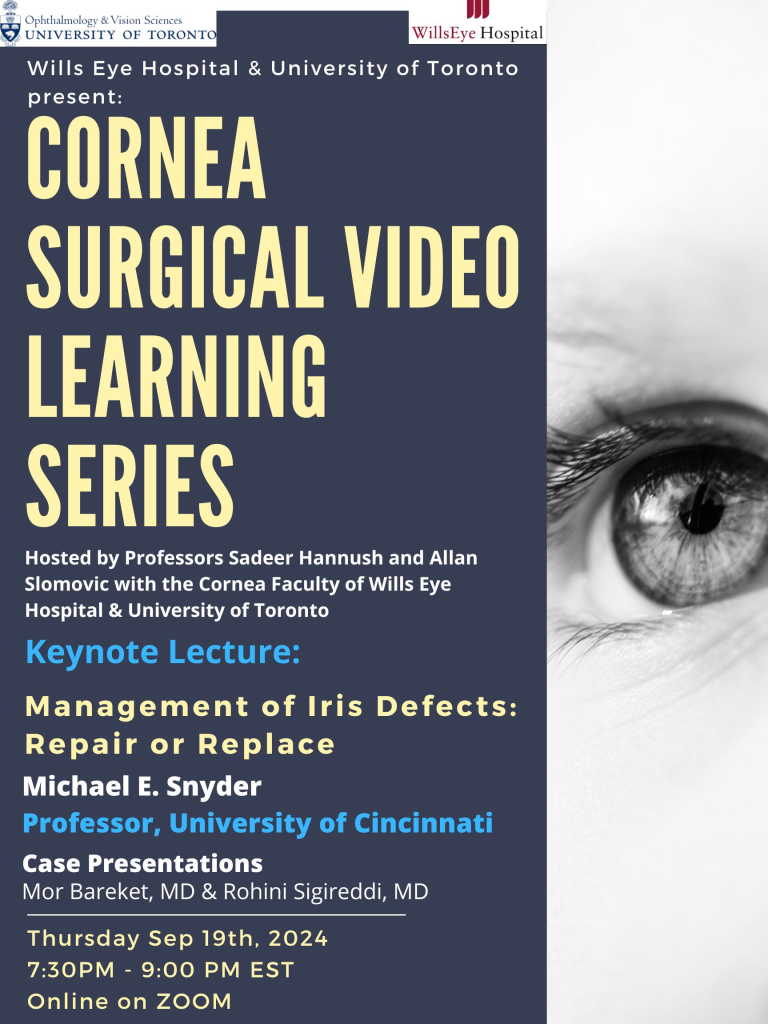
Keynote Presentation:
Professor Michael Snyder, MD, Department of Ophthalmology, University of Cincinnati
Guest panelists: Joshua Teichman, MD FRCSC and Randal Ulate, MD (University of Toronto),
Zeba Syed, MD and Brenton Finklea, MD (Wills Eye Hospital)
Surgery Case Presentations: Rohini Sigireddi, MD (Wills Eye Hospital), Mor Baraket, MD(University of Toronto)
Register in advance for this webinar: https://us02web.zoom.us/webinar/register/WN_ABOjHTL9Rmu7NS9Oh9V1Ag
After registering, you will receive a confirmation email containing information about joining the webinar.
The evening will as usual be recorded and placed online for viewing.
If you would like to visit any of our prior series, please see the link here:
https://ophthalmology.utoronto.ca/subspecialty-rounds
CME credits are available for the following:
· Royal College Maintenance of Certification Section 1: 7.5 hours (1.5 Section 1 hours per session)
· American Medical Association Category 1: 7.5 credits (1.5 Category 1 credits per session)
· European Union for Medical Specialists UEMS-EACCME®: 7.5 credits (1.5 ECMEC credits per session)
4th Global Neuro-Ophthalmology Case Festival
Date: August 24th – 25th, 2024
Time: 4:00 PM – 9:00 PM IST
The 4th Global Neuro-Ophthalmology Case Festival is a two-day celebration of learning, focused on common, complex, and important neuro-ophthalmology disorders with diverse speakers and expert panelists.
The Case Festival will be available for free on YouTube.
Click HERE to access the August 24th livestream
Click HERE to access the August 25th livestream.