

 +1-800-267-5763


Youtube webinars organized by Oftalmo-University

Youtube webinars organized by Oftalmo-University
Access Details
Learn more about the OFTALMO BINARS live/recorded youtube webinars organized by Oftalmo-university
Many of the sessions are in Spanish but there are some sessions in English.
Archived content, with recorded previous sessions can be found here
Videos for Donning & Doffing PPE
The first video shows how to do donning and doffing of PPE during routine care of any patient that is suspected of confirmed COVID-19. This mask protects from droplets.
Droplet Precautions – Donning and Doffing PPE : https://www.youtube.com/watch?v=Ww0Rf079MZ4
The second video shows donning and doffing of PPE with N95 masks to be used when performing aerosolized procedures on patients with suspected or known COVID-19 patients.
Full Precautions – Donning and Doffing PPE: https://www.youtube.com/watch?v=I94lIH8xXg8
Ergonomics for the Ophthalmologist Videos
The COS is pleased to provide access to the presentations on Ergonomics that took place during the 2017 COS Annual Meeting in Montreal, QC. On this page you will find a variety of resources and video presentations on the subject of ergonomics.
CPD Credit
Scanning resources that are relevant to your professional practice by enhancing your awareness of new evidence, perspectives and findings can be claimed as Section 2: Self-Learning under Scanning in MAINPORT with the MOC Program of the Royal College of Physicians and Surgeons of Canada.
Handouts
- Home exercises covering a wide range of motions: 2017 COS Exercise Handout
- Commercial products, websites, books, and equipment and consultation services to improve ergonomic balance: Ergonomics handout
Video Presentation
1. Introduction
Dr. Lorne Bellan’s brief introduction to the ergonomics session.
2. Re-attaching the focus on body mechanics and ergonomics
• George Matos, CAT(C)
During the 2017 COS Annual Meeting, George Matos presented two engaging lectures that encouraged delegates to re-attach their focus on body mechanics and ergonomics. During these sessions Mr. Matos explains the impacts of body positioning in the various aspects of ophthalmology, how this can negatively impact body mechanics and then he provides some tips and exercises to combat the negative effects.
PowerPoint slides for the above session: Matos Current Concepts Talk – Slides
3. The incidence and effects of work-related musculoskeletal injury among ophthalmologists
• Ashley Brissette, MD
Dr. Ashley Brissette presented her findings from a systematic review of current literature regarding ergonomics and work-related MSK injury in the field of ophthalmology.
4. Occupational musculoskeletal pain & injury in Canadian ophthalmologists
• Vlad Diaconita, MD
Dr. Vlad Diaconita presented the results from a survey that was sent out to the COS membership in spring 2017 regarding MSK pain and injury.
Discussion 1
5. Developing an educational module for ergonomics in ophthalmology
• Timothy Ratzlaff, MD
Dr. Timothy Ratzlaff discussed the content and creation of an educational module built by applying the main points highlighted in Ashley Brissette’s literature review.
6. Canadian Ophthalmic Practitioner Ergonomic (COPE) survey
• Femida Kherani, MD
Dr. Femida Kherani presented the results from the COPE survey, which was sent out to multiple listservs in May 2017.
Discussion 2
This resource is only available in English.
3 videos to MAKE your own slit lamp protectors
3 videos on how to make-it-yourself, universal slit-lamp and microscope shield for eye care professionals: ophthalmologists, optometrists.
https://www.youtube.com/watch?v=wvnx_KIUE9A
https://www.youtube.com/watch?v=pXm624pBDUM
https://www.youtube.com/watch?v=G5wxU2UV0nI
Webinar Recordings: Ergonomics and Mindfulness in the Operating Room. Providing Care to Your Patients While Avoiding Becoming One
The Canadian Ophthalmological Society is pleased to provide you to a recording of the webinar on practical ergonomic tips in the ophthalmology operating room, that took place on December 9, 2019.
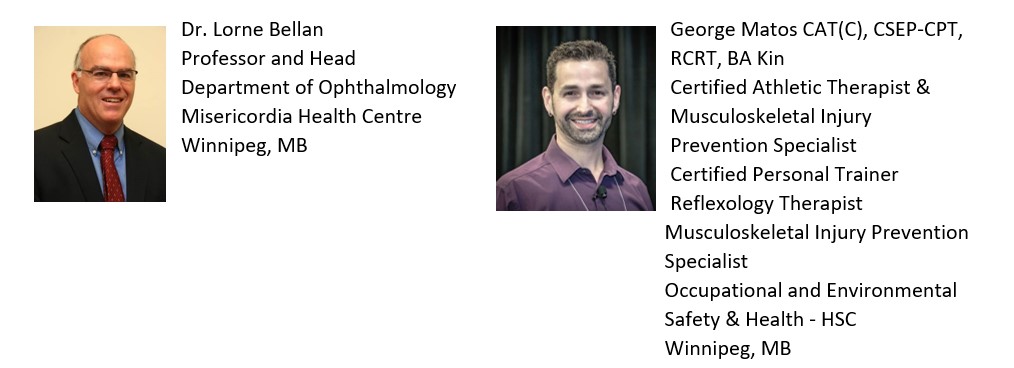
In the session George Matos, Musculoskeletal Injury Prevention Specialist and ophthalmologist Dr. Lorne Bellan review how to adapt your posture to protect yourself through a day of surgery. This webinar includes thoughts to have in mind at the start of your surgical day, including how to set up your foot pedals, chair, operating table and surgical microscope, each to optimize your posture and support during your day of surgery and to minimize the risk of repetitive stress injuries.
Learning Objectives
At the end of this webinar, participants will be able to:
- Describe optimal posture for a day of cataract surgery
- Position foot pedals optimally from an ergonomics perspective
- Set up your surgical chair for optimal arm, leg and back support
- Set the microscope position and angle optimally for your neck
- Re-introduce equipment/movement patterns to lessen musculoskeletal strain that can be overlooked
CPD Credits
This webinar archive is an Accredited Group Learning Activity (Section 1) as defined by the Maintenance of Certification Program of the Royal College of Physicians and Surgeons of Canada, and was approved by the Canadian Ophthalmological Society. You may claim a maximum of 1 hour.
Access Details
To access the archived (recorded) version of the webinar visit the event website: https://event.on24.com/wcc/r/2140596/980B5EE498FA3BA26DF28AC29830E995
This program was delivered with financial support from an educational grant from provided to the COS by the Canadian Medical Association, MD Financial Management and Scotiabank.
A Cost-Effective Wireless HD POV Surgical Recording System
The “A Cost-Effective Wireless, High Definition Point of View Surgical Recording System” video shows how to use off-the-shelf consumer products to record surgeries without breaking the bank.
The resource is designed for oculoplastic surgeons, but could be used for any sub-specialty. The video demonstrates a step-by-step process of how to set up for recording both non-sterile procedures (using a chest mount) and for sterile procedures (using a head mount).
Three primary items needed in a surgeon’s kit are a:
- Point of view camera
- Wireless transmitter
- USB power source
MedSKL
MedSKL offers free videos and downloadable resources from the world’s leading medical professors. All courses provide a description, overview, lecture, and areas for more articles resources for many sub-specialty areas.
The resources are created by doctors for doctors, medical students, pre-medical students, and medical schools and professors who are looking for additional resources and learning tools. Learners have the opportunity to join other ophthalmologists on the discussions pertaining to their area of interest or questions posed based on their learning.
Learning Objectives
After the completion of any given course, the learner should be able to:
- Apply a comprehensive approach, identify when to refer to specialists, and describe the treatment options for conditions
- Recognize clinical conditions that can be lethal
The 6 ophthalmology modules offered are:
- Acute Visual Loss
- Amblyopia
- Chronic Visual Loss
- Diplopia
- Eye Redness
- Strabismus
Visit MedSKL today to register for courses.
CRS “Snapshot of the Month”: Luck of the Draw
The Canada Retina Society (CRS) publishes an interesting and educational Vitreo-Retinal related image every three months – a ‘Snapshot of the Month.’ This quarter’s snapshot was written by Fannie Nadeau and Ananda Kalevar, MD (Department of Ophthalmology, HD Hospital, Sherbrooke University, Quebec).
Snapshots entitled “Luck of the Draw” tell the story of an 80-year-old female experimented nasal visual field loss in her right eye (OD) with preserved temporal visual field. The patient had a cilioretinal artery; an anatomic variant found in 15 to 30% of the population that often supplies the papillomacular bundle, but that supplies the foveola in only 10% of eyes.
To see this quarter’s images and read more, please take a look on the Canadian Retina Society website.
If you are interested in submitting a “Snapshot of the Month” for consideration, please see the SOTM Submission process requirements and guidelines.
Make the Difference: Preventing Medical Trainee Suicide
Access Details
Learn more about the American Foundation for Suicide Prevention and their initiatives.