


 +1-800-267-5763


Written by: Mostafa Bondok, Yusuf Ahmed, Patrick Gooi, R. Rishi Gupta, and Stephanie Dotchin
Ergonomic attention in the operating room tends to focus on what the surgeon can see: the microscope, the operative field, and the hands. Yet, the foot pedal setup, the surgeon’s base of support, is among the most overlooked elements of surgical positioning. During vitrectomy surgery, for instance, surgeons simultaneously operate two distinct pedals. These pedals often differ substantially in height, size, and placement, which can translate into sustained hip imbalance and lumbar strain across a surgical list.
While this is largely an industry design problem, it translates into a surgeon problem as the body pays the price. Ophthalmologists are well positioned to advocate for change by providing direct feedback to manufacturers and raising ergonomic design as a priority in equipment procurement, including making the case for adjustable pedal height, which would allow accommodation of the full range of surgeon body types.
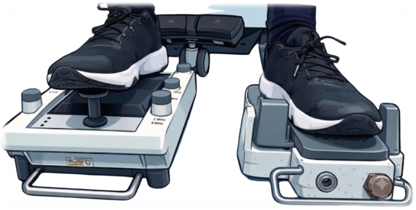
Placement: Width, Position and Symmetry
Pedals should be positioned approximately shoulder-width apart, at a distance that does not require reaching forward or pulling the feet back. Pedals placed too far forward shift the pelvis anteriorly and increase lumbar lordosis. Pedals placed too close cause the knees to crowd the underside of the table and force the ankle into active dorsiflexion. Having the foot pedals externally rotated 15 degrees (not parallel to each other) tends to be more comfortable and allows the legs and feet to match the hip joint’s natural external rotation. When the surgeon is seated superiorly and the standard table configuration prevents neutral placement, rotating the table’s wheels sideways (as demonstrated in the illustration below) or repositioning the slightly can allow the surgeon to move closer to the operative field without reaching.
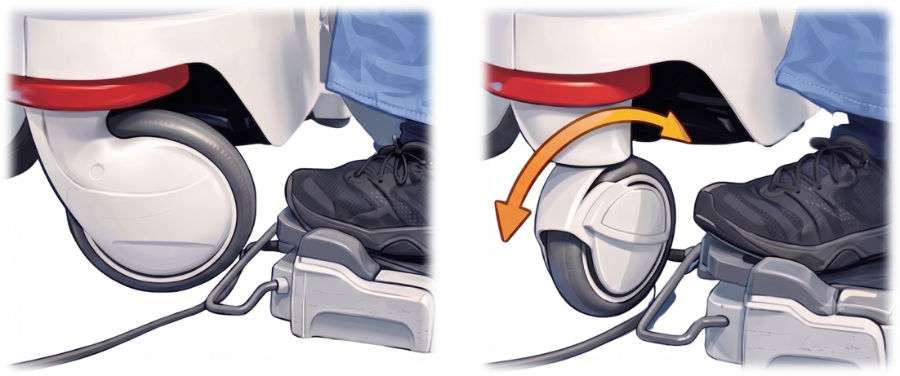
Distributing the Load
Using the same foot for each pedal throughout every case on a surgical list may repeatedly load the body in the same asymmetric pattern. Where feasible, the surgeon should consider alternating which foot controls each pedal between right- and left-eye cases. This distributes the workload more evenly and reduces the duration of sustained asymmetry.
Pedals should also be repositioned whenever the chair or table is moved. A pedal that was comfortable at the start of the case may become too distant after a positional adjustment. The surgeon should avoid compensating by sliding forward in the chair or reaching with the leg, as both cause the pelvis to lose contact with the lumbar support.
Raising the Pedals for Shorter Surgeons
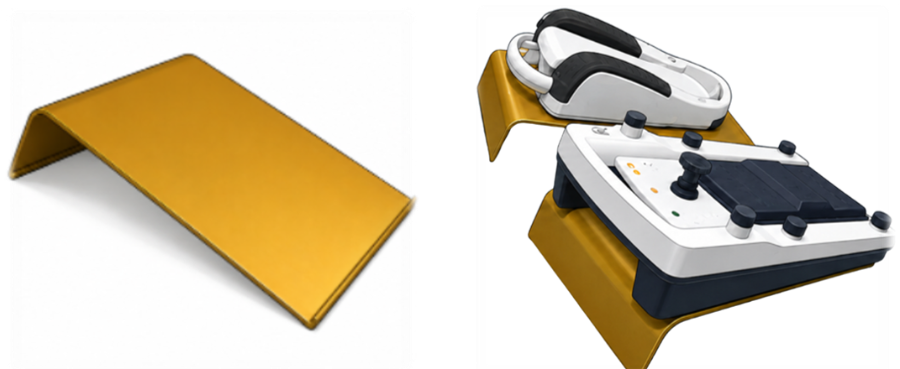
When the table must be elevated to bring the surgical field within reach, the foot pedals may rise beyond comfortable contact, requiring active hip flexion or toe-pointing to operate them. This fatigues the hip flexors and destabilizes the pelvis. The surgeon can place a stable wedge or folded, firm towel beneath the pedal to bring it to a comfortable height. This keeps the foot flat, the ankle neutral, and the lower limbs relaxed. Any support should be secure and should not interfere with pedal control.
Positioning for Protection: An Ergonomic Framework for the OR Table
In practice, table height and patient head position directly determine whether the surgeon can maintain neutral posture, or is forced to lean, reach, and compensate.
Table Height: The Cascade Effect
Operating table height is the single adjustment that most influences everything that follows. Set the table too high, the surgeon must raise the chair to re-align with the microscope—but a higher chair raises the knees, reduces thigh support, and forces the feet to reach downward for the pedals. Set the table too low, the surgeon must lower the chair, the oculars may sit too high for comfortable alignment, and the tendency to lean forward increases.
As a starting principle, the surgeon should set the table so the patient’s eye level allows neutral neck and shoulder posture at the adjusted chair height. Then, the surgeon should optimize the microscope and finally, confirm pedal access.
When operating superiorly: The surgeon should position the patient’s head so it overhangs the edge of the table by a few centimetres, when safely tolerated. This draws the operative eye closer to the surgeon and reduces the need to lean forward at the waist.
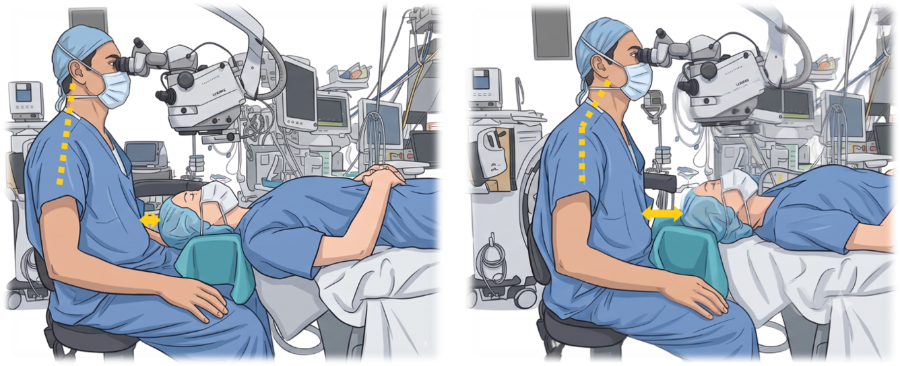
When operating temporally: The patient’s head should be rotated toward or away from the surgeon as needed. During lateral rectus surgery, for example, sitting opposite the temporal side and rotating the patient’s head toward the surgeon keep the operative eye closer to the table’s edge, reducing lateral lean and forward reach simultaneously.
Reverse Trendelenburg with Neck Extension When Seated Temporally
Surgeons with long legs or a relatively short torso often find that lowering the table enough for neutral ocular alignment brings the knees into contact with the table’s underside, particularly when seated temporally. Reverse Trendelenburg elevates the head end of the table, creating additional clearance beneath the table. However, tilting the table alone also tilts the patient’s head and operative field. Positioning the patient with a slight neck extension counteracts this tilt, returning the patient’s face and operative eye to a more horizontal plane for microscope alignment. If contact with the table persists, the surgeon can separate the pedals slightly to allow the legs to straddle the table base using the minimum separation necessary, as a wide pedal stance increases hip external rotation.

Repositioning the Surgeon and Patient as the Case Progresses
While the case often begins in optimal alignment, patients may lift their chin, turn their head, or shift laterally. The natural response of the surgeon is to move the microscope to re-centre on the eye. But, if the surgeon does not reposition the body to match the patient’s new position, the oculars drift away from the surgeon’s natural resting gaze, and the surgeon compensates by leaning or rotating the trunk. When the patient moves, the surgeon should reposition them whenever it is safely possible. If that is not feasible, the surgeon should move the chair and pedals together with the microscope so the entire setup remains aligned.
Maintaining a Relaxed Posture
Many surgeons were taught to “sit up straight, shoulders back, and spine aligned.” In the OR, that instinct may work against them. A rigid, upright posture quickly fatigues muscles and invites compensation elsewhere in the body. Instead, the surgeon should ask: If I relaxed completely, where would my eyes naturally fall? If they’re not in the oculars, an adjustment is needed. Excessive effort to keep the eyes within the oculars should serve as a signal to adjust the microscope, chair, or patient.

The Canadian Medical Association, MD Financial Management Inc. and Scotiabank proudly support the COS Ergonomics and Injury Prevention Campaign, one of several initiatives that comprise their $115 million commitment to supporting the medical profession and advancing health in Canada.